US Population by Time Zone: 47% of Americans Live on Eastern Time
By Marko Visic · Published Nov 28, 2026 · Updated Nov 28, 2026
Election nights, kickoff times and the twice-a-year clock change all turn on one question: how many people are on each clock?
We counted: each of the Census Bureau's 242,335 block groups went into the time zone the Department of Transportation draws around it. The totals below are the result, for the 2020 Census and for July 1, 2025.
About 160.8 million people, 47.1% of US residents, live in the Eastern Time Zone. Central has 99.5 million (29.1%), Pacific 55.3 million (16.2%), Mountain 24.0 million (7.0%), Hawaii–Aleutian 1.4 million (0.4%) and Alaska 736,810 (0.2%). These are July 1, 2025 estimates for the 50 states and DC.
Our calculation from Census block-group centers of population, BTS time zone boundaries and the Vintage 2025 population estimates. Method below.
US population by time zone
Three of every four residents, 76.2%, live on Eastern or Central Time. When it is 9:00 p.m. in New York it is 8:00 p.m. in Chicago, so anything that starts at that hour reaches those 260.4 million people between 8:00 and 9:00 in the evening.
Mountain Time covers 6 whole states and parts of 8 more, yet holds 7.0% of residents: 24.0 million, against 55.3 million on Pacific Time.
| Time zone | Standard time | People, July 1, 2025 | Share | 2020 Census | Change | States |
|---|---|---|---|---|---|---|
| Eastern | UTC−5 | 160,818,666 | 47.1% | 155,825,443 | +3.2% | 18 whole, 5 in part |
| Central | UTC−6 | 99,531,816 | 29.1% | 95,770,953 | +3.9% | 10 whole, 10 in part |
| Pacific | UTC−8 | 55,274,001 | 16.2% | 54,911,459 | +0.7% | 2 whole, 3 in part |
| Mountain | UTC−7 | 23,990,284 | 7.0% | 22,752,764 | +5.4% | 6 whole, 8 in part |
| Hawaii–Aleutian | UTC−10 | 1,433,280 | 0.4% | 1,455,730 | −1.5% | 1 whole, 1 in part |
| Alaska | UTC−9 | 736,810 | 0.2% | 732,932 | +0.5% | 1 in part |
| 50 states and DC | 341,784,857 | 100% | 331,449,281 | +3.1% |
DC counts as a whole state here. Standard-time offsets: 15 U.S.C. 263 and the BTS layer. 2025 figures are our estimates; the 2020 column is the census count.
Since the 2020 Census, Mountain Time has grown fastest, by 5.4%, against 3.1% for the country. Pacific Time added 0.7%, and Hawaii–Aleutian Time lost people.
Map of US time zones by population
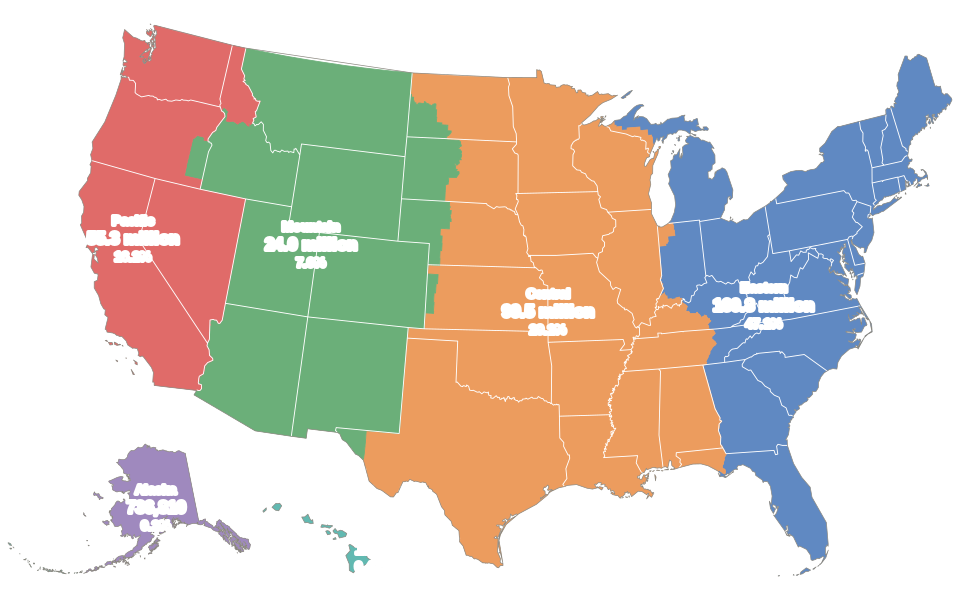
Zone boundaries: BTS, National Transportation Atlas Database, simplified for drawing. Populations: our calculation. The interactive US Time Zone Map shows the live local time in each zone.
The 14 states split between two time zones
In nine of the 14, one zone holds more than nine residents in ten. Tennessee is the most evenly split: 34.3% of its residents are on Eastern Time. South Dakota follows with 26.0% on Mountain Time, then Kentucky with 23.4% on Central. In Florida the Central Time panhandle holds 1.2 million people, 5.0% of the state, and in Texas the Mountain Time counties of El Paso and Hudspeth hold 881,291, 2.8%.
| State | Larger part | People, 2025 | Share | Smaller part | People, 2025 | Share |
|---|---|---|---|---|---|---|
| Alaska | Alaska | 736,810 | 99.94% | Hawaii–Aleutian | 460 | 0.06% |
| Florida | Eastern | 22,280,114 | 95.0% | Central | 1,182,404 | 5.0% |
| Idaho | Mountain | 1,631,033 | 80.4% | Pacific | 398,700 | 19.6% |
| Indiana | Eastern | 5,763,544 | 82.7% | Central | 1,209,789 | 17.3% |
| Kansas | Central | 2,966,334 | 99.63% | Mountain | 10,886 | 0.37% |
| Kentucky | Eastern | 3,530,635 | 76.6% | Central | 1,076,229 | 23.4% |
| Michigan | Eastern | 10,053,074 | 99.3% | Central | 74,810 | 0.7% |
| Nebraska | Central | 1,917,202 | 95.0% | Mountain | 100,804 | 5.0% |
| Nevada | Pacific | 3,277,582 | 99.86% | Mountain | 4,606 | 0.14% |
| North Dakota | Central | 747,245 | 93.5% | Mountain | 52,113 | 6.5% |
| Oregon | Pacific | 4,241,390 | 99.2% | Mountain | 32,196 | 0.8% |
| South Dakota | Central | 691,967 | 74.0% | Mountain | 243,127 | 26.0% |
| Tennessee | Central | 4,802,529 | 65.7% | Eastern | 2,512,547 | 34.3% |
| Texas | Central | 30,828,530 | 97.2% | Mountain | 881,291 | 2.8% |
July 1, 2025 estimates. Zones are the legal ones of 49 CFR Part 71; a town that keeps its neighbor's clock by local habit is counted in its legal zone.
Ten counties the time zone line cuts in two
Almost everywhere the boundary follows state or county lines. In ten counties it does not: it follows a river, a highway, survey lines or a city limit, and neighbors a few miles apart keep different clocks. We counted these counties by Census block.
Nevada is on Pacific Time except the city of West Wendover, whose 4,512 residents (2020 Census) are on Mountain Time, like neighboring Utah. In Alaska, 459 people in the western Aleutians are in the Hawaii–Aleutian zone.
| County | The line follows | 49 CFR | People on each side, 2020 Census | |
|---|---|---|---|---|
| Aleutians West Census Area, AK | the meridian 169°30′ W in the Aleutian Islands | § 71.12 | Alaska 4,773 | Hawaii–Aleutian 459 |
| Gulf County, FL | the Intracoastal Waterway | § 71.5(f) | Eastern 6,941 | Central 7,251 |
| Idaho County, ID | the Salmon River | § 71.9(a) | Mountain 1,538 | Pacific 15,003 |
| Cherry County, NE | range and section lines | § 71.7(c) | Central 4,164 | Mountain 1,291 |
| Elko County, NV | the city limits of West Wendover | § 71.9(b) | Mountain 4,512 | Pacific 49,190 |
| Dunn County, ND | the Little Missouri River | § 71.7(a) | Central 274 | Mountain 3,821 |
| McKenzie County, ND | the Yellowstone River and township lines | § 71.7(a) | Central 13,753 | Mountain 951 |
| Sioux County, ND | State Highway 31 | § 71.7(a) | Central 3,803 | Mountain 95 |
| Malheur County, OR | a township line in the south of the county | § 71.9(a) | Mountain 31,507 | Pacific 64 |
| Stanley County, SD | a line running southwest from the rail crossing near Pierre | § 71.7(b) | Central 1,474 | Mountain 1,506 |
Where the line runs: 49 CFR Part 71. People on each side: 2020 Census blocks (TIGER/Line 2020) placed in the BTS zone polygons, our calculation.
Who changes clocks in March 2027, and who doesn't
Clocks go forward at 2:00 a.m. on Sunday, March 14, 2027, and back on Sunday, November 7, 2027 (15 U.S.C. 260a). About 332.8 million people, 97.4% of the residents of the 50 states and DC, will change them.
About 9.0 million will not (2.6%): the 1,432,820 residents of Hawaii and the 7,623,818 of Arizona, less the Navajo Nation. The law lets a state stay on standard time all year, and NIST lists Hawaii and Arizona as the two that do, “with the exception of the Navajo Indian Reservation, which does observe DST” (NIST). The reservation's Arizona part counted 94,511 people at the 2020 Census.
The territories keep one time all year too: Puerto Rico, the US Virgin Islands, Guam, the Northern Mariana Islands and American Samoa (Congressional Research Service), 3.6 million people at the 2020 Census.
Puerto Rico and the island territories
Three of the nine legal zones lie outside the 50 states. None of them changes clocks.
| Territory | Time zone | Standard time | 2020 Census | July 1, 2025 |
|---|---|---|---|---|
| Puerto Rico | Atlantic | UTC−4 | 3,285,874 | 3,184,835 |
| US Virgin Islands | Atlantic | UTC−4 | 87,146 | no estimate |
| American Samoa | Samoa | UTC−11 | 49,710 | no estimate |
| Guam | Chamorro | UTC+10 | 153,836 | no estimate |
| Northern Mariana Islands | Chamorro | UTC+10 | 47,329 | no estimate |
Puerto Rico: 2020 Census and Vintage 2025 estimate. Island Areas: 2020 Island Areas Censuses; the Vintage 2025 estimates do not cover them.
How we counted
- Block groups into zones. The Census Bureau publishes the center of population of every 2020 block group, 242,335 in the 50 states, DC and Puerto Rico (Centers of Population). Each went into the zone polygon that holds its center, using the boundaries BTS publishes for the Department of Transportation, which sets them (NTAD Time Zones). 5 centers, 10,294 people, sat just outside every polygon on a coast or border and went to the nearest one.
- Whole counties, except ten. Where the legal line follows a state or county line, the whole county goes to one zone. In two counties on the Arizona–California line a block group's center fell across the drawn boundary, 252 people in all; the law puts each county in one zone, so they stay whole. The ten counties the line cuts (49 CFR Part 71) were counted by Census block, each block in the zone that holds its internal point.
- 2025. Each county's July 1, 2025 estimate (Vintage 2025) goes to its zone. A divided county's estimate is split in the proportions of its 2020 blocks, which assumes both sides grew alike.
- Checks. The zones add up to the Census Bureau's own totals: 331,449,281 for the 2020 Census and 341,784,857 for July 1, 2025.
Limits: the zones are the legal ones, so a place that keeps another clock by habit is counted where the law puts it. Outside the ten divided counties a block group is never split. The Navajo Nation figure is a 2020 count (Census block assignment files), because no later one exists.
Download the data and cite it
The data is free to use under Creative Commons BY 4.0: by zone, by state and for the ten divided counties.
How to cite: SimpleMapLab (2026). US Population by Time Zone. https://www.simplemaplab.com/studies/us-population-by-time-zone
Sources
- US Census Bureau, Centers of Population, 2020 Census: block groups (CenPop2020_Mean_BG.txt)
- US Department of Transportation, Bureau of Transportation Statistics, National Transportation Atlas Database: Time Zones (boundaries of the nine zones; updated January 5, 2023)
- 49 CFR Part 71, Standard Time Zone Boundaries (October 1, 2024 edition)
- 15 U.S.C. 263, Designation of zone standard times
- 15 U.S.C. 260a, Advancement of time or changeover dates
- US Census Bureau, Vintage 2025 Population Estimates: states (NST-EST2025-ALLDATA) and counties, July 1, 2025
- US Census Bureau, TIGER/Line Shapefiles 2020: tabulation blocks with 2020 Census population (POP20)
- US Census Bureau, 2020 Census Block Assignment Files (American Indian areas)
- US Census Bureau, First 2020 Census U.S. Island Areas Data Released Today (October 28, 2021)
- National Institute of Standards and Technology, Daylight Saving Time (DST)
- Congressional Research Service, Daylight Saving Time (DST), report R45208
Related on SimpleMapLab
- US Time Zone Map: the zones with their live local times
- Time Zone Finder: the zone of any place or address
- Time Difference Calculator: hours between two places
- World Time Zone Map: every zone on Earth
- The Elevation Americans Live At: the same block groups, counted by height above sea level
- The 100-Mile Radius Around Every US State Capital: another population study
Questions about US time zones and population
Corrections welcome at hello@simplemaplab.com.